
Rock That Resume
Didac Jorda
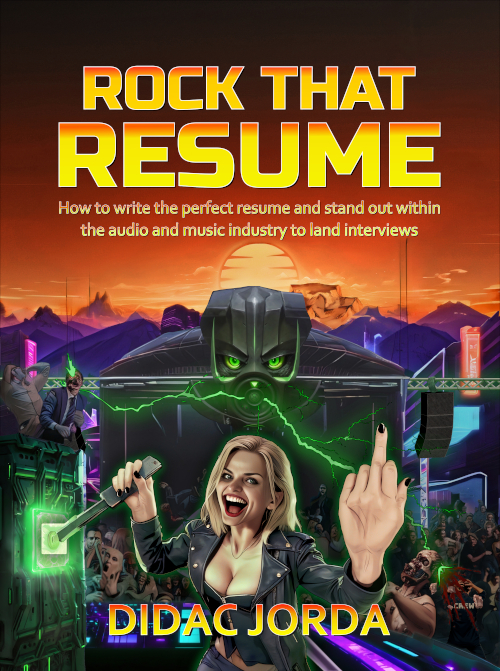
How to write the perfect resume and stand out within the audio and music industry to land interviews.
Book Overview
I wrote “Rock That Resume” after watching too many talented audio professionals get their applications ignored by companies that desperately needed their exact skills. I’d see sound engineers, DSP specialists, and music production experts with incredible technical abilities, yet they couldn’t get past the first screening round.
After spending 520 hours researching, writing, and refining this guide, I realized the problem wasn’t their lack of talent. It was that nobody taught us how to translate our passion for audio into a language that both hiring algorithms and human recruiters could understand.
The audio industry operates differently than usual companies. We’re passionate people who often stumble into this field because we love music, sound, or technology. But when it comes to job hunting, that passion needs strategic presentation. I’ve been there myself, sending out generic resumes and wondering why companies weren’t responding, even when I had exactly what they needed.
This book tackles the specific challenges we face as audio professionals. Whether you’re a recent graduate trying to break into the industry or a seasoned engineer looking to make your next career move, the traditional resume advice simply doesn’t address our unique situation. We work with specialized software, deal with highly technical concepts, and often have diverse project-based experience that doesn’t fit neatly into conventional resume formats.
The reality hit me hard when I realized that most of us approach resume writing the same way we approach mixing, focusing on perfecting every technical detail while forgetting that the end listener (in this case, the hiring manager) needs to connect with what we’re presenting on an emotional level first.
Format Strategy and Design
Rather than pushing trendy design templates, I advocate for strategic simplicity. My approach recognizes that busy recruiters need accessible information, not artistic showpieces. The book demonstrates how chronological and functional formats serve different career stages, as recent graduates benefit from chronological structure while career changers might leverage functional approaches.
What sets this guidance apart is its emphasis on adaptability. Instead of rigid templates, readers will learn to create flexible frameworks that can be quickly customized for specific opportunities without complete redesigns.
AI Integration Guidelines
Recognizing AI’s growing role in job searching, the book provides balanced guidance on leveraging these tools effectively. Rather than dismissing or over-embracing artificial intelligence, I’ll teache strategic usage that enhances authenticity rather than replacing it.
The AI section includes specific prompts and techniques for improving content clarity while maintaining personal voice. We’ll review the drawbacks of over-reliance on generated content, showing why genuine professional narratives outperform generic AI outputs.
Navigating Digital Screening
Modern hiring relies heavily on automated systems, yet most professionals remain clueless about optimizing for these digital gatekeepers. I dedicate a chapter to demystify Applicant Tracking Systems (ATS), explaining how formatting choices can make the difference between human review and automatic rejection.
The book provides practical solutions: maintaining both formatted and plain-text versions, selecting ATS-friendly fonts, and avoiding common formatting pitfalls that confuse automated parsers. These technical insights prove invaluable when competing for positions at companies using modern recruitment technology.
Authentic Communication
There is a cover letter section to show you a few methods to customize it for the company. Hiring managers can instantly recognize form letters, and while there is nothing inherently wrong with templates, making personalized communication is in fact essential for standing out in competitive markets.
The book outlines fundamental principles, like proper research techniques, concise value proposition development, and effective calls-to-action that encourage engagement. I particularly emphasize avoiding AI-generated cover letters, advocating instead for authentic, research-driven communication.
Smart Keyword Integration
The book’s standout contribution involves keyword strategy that goes beyond simple stuffing. I introduce a “Generative Keyword Mapping Methodology”, a systematic approach for identifying terms that resonate with both automated systems and human reviewers.
Rather than creating lengthy skill lists, I’ll show you contextual integration. Instead of listing “MATLAB” as a standalone skill, readers will learn to embed it within project descriptions that demonstrate actual application and measurable outcomes. This approach satisfies ATS requirements while providing hiring managers with meaningful context.
Industry Focus
Unlike generic career guides, this book acknowledges the audio industry’s unique culture where technical competence must align with genuine passion for sound quality and musical expression. Every recommendation is guided by this understanding, ensuring advice resonates with industry-specific hiring practices.
The comprehensive appendix provides detailed keyword references for various roles that span from DSP engineers to marketing specialists, making the book valuable for diverse audio industry career paths.
Professional Storytelling
I’ll show you a five-step work experience framework that will transform generic work experience descriptions into targeted marketing narratives. This process includes thorough company research, competitive analysis, and strategic content selection that addresses specific employer pain points.
I emphasize progressive storytelling, by organizing experiences to demonstrate career advancement while maintaining relevance to target positions. The book includes numerous before-and-after examples showing how small adjustments create dramatic improvements in impact and clarity.
Implementation Resources
The book concludes with actionable tools, such as software recommendations, organizational frameworks, and maintenance strategies for keeping resume content current. These practical elements will transform theoretical knowledge into implementable systems for ongoing career development.
“Rock That Resume” functions as both reference guide and practical workbook, providing audio industry professionals with specialized knowledge for navigating competitive job markets while maintaining authentic professional representation throughout their career journey.
Audio Resume Toolbox
This book is paired with a section dedicated exclusively to share resources to help with the tedious work of writing resumes. I will share with you templates, font types, prompts and other tools, like free software which you can use to edit visually your resume, and add a personal touch. You can access to that by going to Audio Resume Toolbox. That page is constantly evolving (hopefully for the better), so expect to see changes nearly every time you get there.
Your experience matters
I’ve poured more hours into this book than I should’ve trying to cover everything I thought you’d need, but I’m realistic enough to know I probably missed something important to your specific situation. The audio industry is vast, and everyone’s career path is different.
If you find yourself stuck on something I didn’t address, or if you have a unique challenge that doesn’t fit the examples I’ve shared, please reach out. You can find me on LinkedIn or drop me a message through my website’s contact page. I genuinely want to help when I can, and your questions often lead to better content for future editions.
Your real-world experiences and struggles are what make this work meaningful. Don’t hesitate to share what’s not working for you, because it might be exactly what the next person needs to hear about too.